Our verdict
- Finseo is the strongest fit for organizations that want German hosting, EU data residency, detailed citation and competitor reporting, API/MCP access and branded agency reports.[18] It also ties visibility to revenue through AI referral analytics (GA4, Piwik PRO or Matomo) and survey-based attribution matched to orders, and it analyzes AI crawler visits from server logs and CDNs such as Cloudflare and Akamai. A read-only MCP server is included from the Starter plan, alongside a REST API.
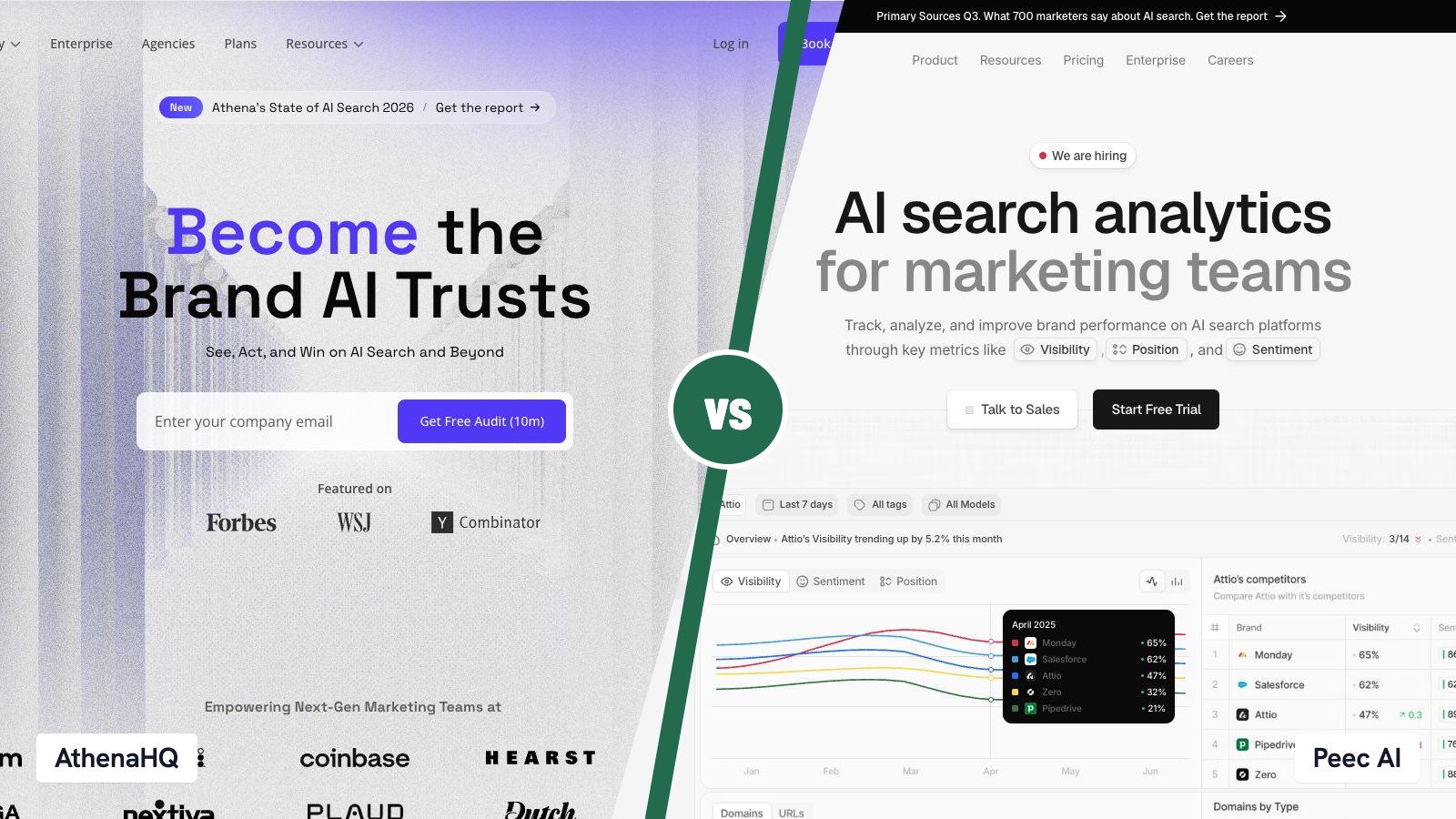
- Peec AI has the clearest published self-serve limits, starting at $95 per month for 50 prompts and a calculated 4,500 monthly AI answers across three active models.[6]
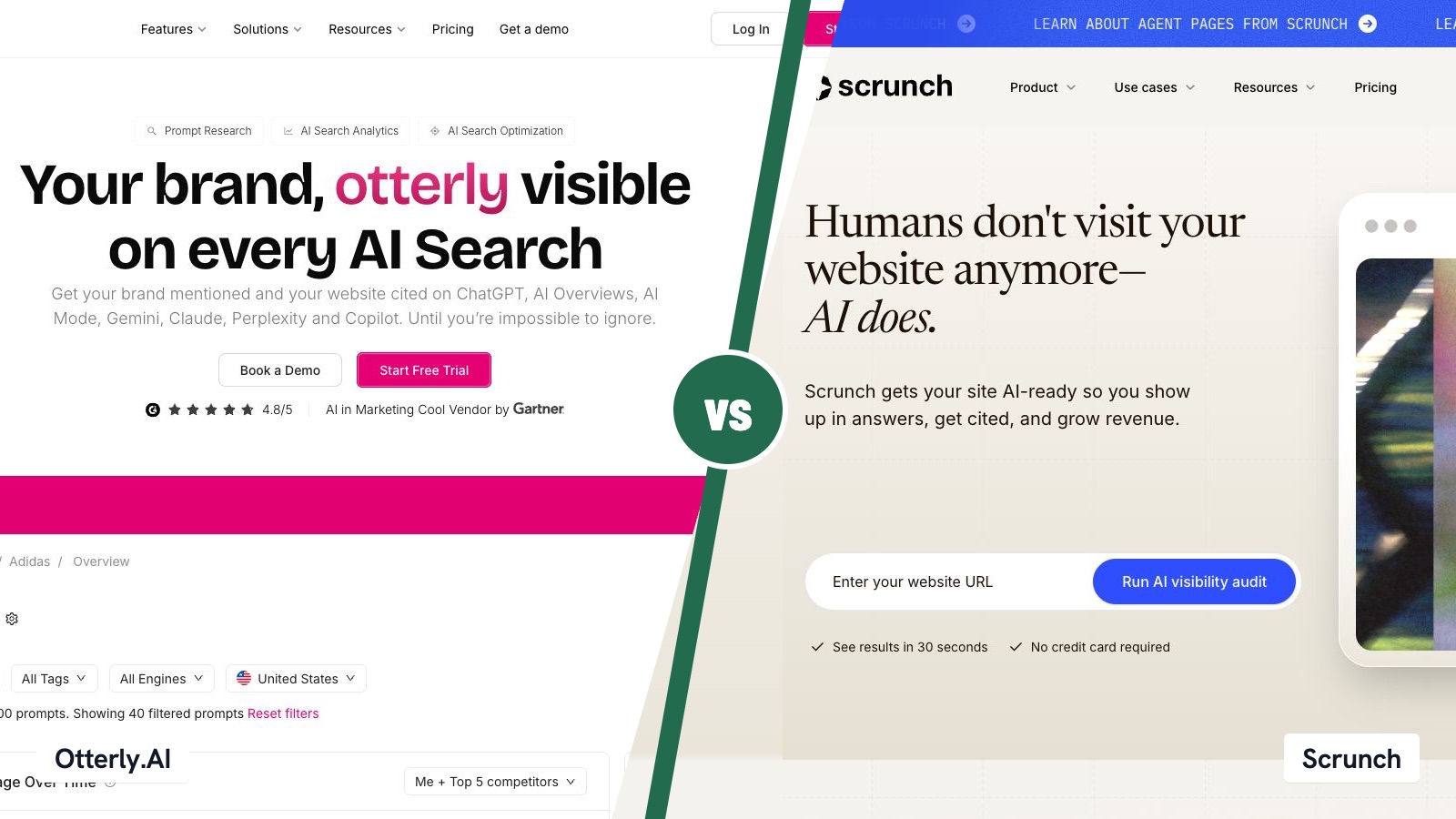
- Otterly.AI has the lowest published entry price at EUR 29 per month, but its plans use engine-weighted credits rather than a simple response quota.[4]
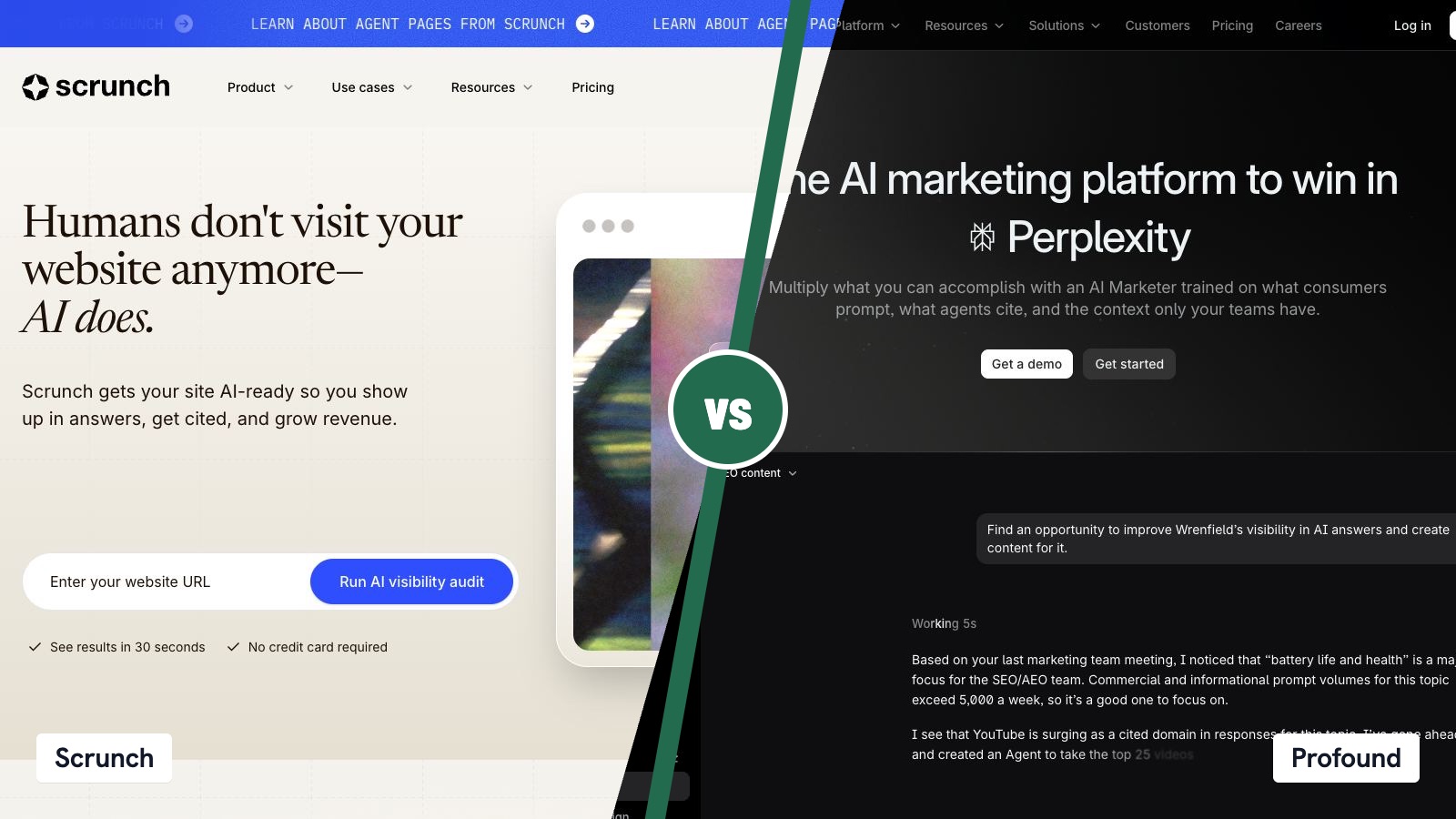
- Profound is aimed at enterprise teams: its paid plan is custom-priced, while API and MCP access are positioned for Enterprise.[4]
- Scrunch is the clearest fit for agencies that need full responses, citations, APIs and explicitly documented white-label outputs.[17][27]
- Finseo is the best fit for buyers prioritizing German hosting, EU data residency, citation and competitor analysis, API/MCP access and white-label agency reports.[18]
 ChatGPT
 Claude
 Perplexity
Profound, Peec AI, Otterly or Scrunch: Which AI Visibility Tool Fits in 2026?
AI visibility platforms differ less by headline feature lists than by their commercial units, engine coverage, collection methods, agency workflows and data-residency commitments. For buyers comparing Profound, Peec AI, Otterly.AI, Scrunch and Finseo, the clearest fits are Peec for transparent self-serve limits, Otterly for the lowest entry price, Scrunch for documented white-label delivery, Profound for enterprise-first deployment and Finseo for German hosting, broad GEO workflows and API/MCP access.
What should buyers compare first?
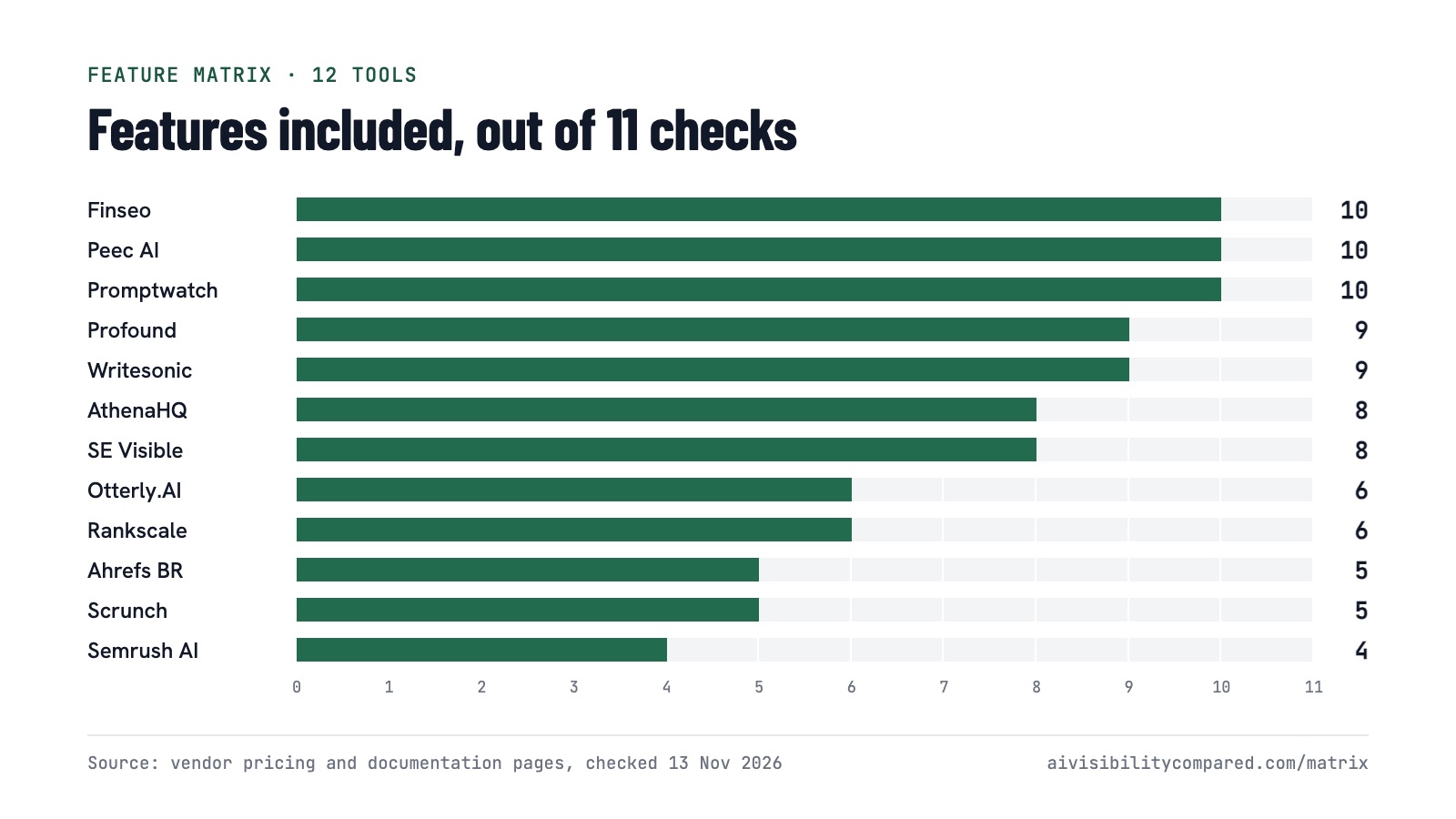
The most useful comparison is not “which tool has the most features?” It is whether each platform measures the same workload in a comparable way. Peec publishes prompts and calculated answers, Otterly uses credits whose cost varies by engine, Scrunch publishes a response allowance, Profound leaves paid quotas custom, and Finseo’s reviewed pricing page does not publish monetary prices or prompt and answer quotas.
Compare these five questions before choosing:
- Which engines and geographic markets are available on the plan you would actually buy?
- Does the platform sell prompts, answers, responses or credits?
- Does it expose cited URLs, competitor comparisons and sentiment?
- Are API, MCP, white-label reporting and agency workspaces included?
- Can the vendor contractually meet your security and data-residency requirements?
This matters because daily AI rankings are not stable snapshots. In Finseo’s predominantly DACH customer-selected sample, only 38.4% of ChatGPT cited URLs and 65.5% of Perplexity cited URLs reappeared the following day.[1]
What is AI visibility tracking?
AI visibility tracking measures how often a brand appears in AI-generated answers, which sources those systems cite, where competitors appear and how responses change over time. The tracked signals commonly include mentions, citations, position, sentiment, share of voice and competitor performance.[2]
It is related to generative engine optimization, or GEO, but it is not identical to traditional search rank tracking. AI answers may synthesize several sources, change with location and model, and expose different underlying searches. Finseo’s query-fan-out study found that ChatGPT ran an average of 1.36 searches per answer, while 96.8% of a prompt’s recorded searches shared no identical search string across consecutive daily runs in the reported sample.[3]
The practical implication is simple: use an AI visibility platform to identify repeatable patterns and content opportunities, not to treat one daily score as a permanent ranking.
How do Finseo, Profound, Peec AI, Otterly and Scrunch compare on pricing and features?
Checked against the research report’s vendor pricing, product and security pages on 16 November 2026. “Not published” means the reviewed public material did not provide a specific figure or commitment.
| Criterion | Finseo | Profound | Peec AI | Otterly.AI | Scrunch |
|---|---|---|---|---|---|
| Entry price and billing | Not published on the reviewed pricing page; brand plans use monthly or annual billing.[4] | Free seven-day trial; paid Enterprise is custom-priced.[5] | $95/month, billed monthly; higher self-serve plans are $245 and $495/month.[6] | EUR 29/month for Lite; monthly and annual subscriptions are available.[4] | $250/month for Core; Enterprise is custom-priced.[7] |
| Engines on entry plan | Three selected models; the model guide lists ChatGPT, Perplexity, Google AI Overviews, Google AI Mode, Claude and Grok among supported options.[5][4] | Trial covers ChatGPT, Gemini and Google AI Overviews; Enterprise supports broader configurable coverage.[5][4] | Three active models on Starter.[6] | Four of seven engines on Lite; named engines include ChatGPT, Google AI Overviews, Perplexity, Copilot, Google AI Mode, Gemini and Claude.[4] | Core supports ChatGPT, Perplexity, Google AI Overviews and Copilot.[4] |
| Prompts and answers | Not published on the reviewed pricing page.[4][6] | Trial includes 50 unique prompts run daily for seven days; answer quota is not published.[5] | 50 prompts and 4,500 calculated monthly AI answers on Starter.[6] | 16 prompts and 2,000 credits on Lite; one check on one engine costs one credit, while Claude costs three.[4] | 125 unique prompts and 5,000 responses per month on Core.[7] |
| Citation and competitor tracking | Visibility, mentions, citations, cited sources and competitors are documented.[2] | Mentions, cited sources, sentiment and competitor benchmarking are documented.[2] | Mentions, source usage, position and sentiment are documented.[2] | Mentions, citations, sentiment, share of voice, average rank and cited URLs are documented.[2] | Responses API returns full answers, citations, competitors and metadata.[8] |
| API | Public REST API; plan mapping is not fully aligned between API documentation and current pricing names.[6][9] | Enterprise. | Pro, Advanced, Enterprise and agency plans; not Starter.[10] | Standard and higher.[11][4] | Enterprise. |
| MCP | Available for Claude, ChatGPT and Cursor, with OAuth 2.1 for Claude and ChatGPT.[12] | Enterprise. | Listed on all plans.[13][10] | Standard and higher, using OAuth 2.0.[11] | Enterprise and custom access.[4][7] |
| White label | Branded reports with agency and client logos, colors and fonts.[14][15] | Native white-label output not published; Agency Mode provides separate client workspaces.[15] | Branded-report workflow through MCP and Lovable; native dashboard white labeling is not established.[15] | No native white-label interface; Looker Studio is the recommended workaround.[16] | Fully white-labeled outputs are documented for agencies.[17][9] |
| Data residency | Frankfurt, Germany, with EU data residency; a DPA is available for every organization.[18] | Hosting region and residency commitment not published in the reviewed material. | Customer data hosted in the EU, primarily Germany, on GCP.[19] | Hosting region and residency commitment not published. | Hosting region and residency commitment not published. |
How were these AI visibility tools compared?
The comparison uses the same criteria for all five platforms:
- Commercial unit: entry price, billing period, prompts, answers, responses or credits.
- Engine coverage: models and search surfaces available on the entry or first operational plan.
- Measurement depth: citations, cited URLs, competitors, sentiment and response-level access.
- Workflow access: API, MCP, integrations, agency workspaces and white-label reporting.
- Security: public certifications, DPA availability, hosting location and explicit residency commitments.
- Buyer fit: the use case that best matches the published capabilities and limitations.
Prices and plan limits are vendor-published figures reviewed on 16 November 2026. A missing figure is reported as “Not published” rather than estimated.
1. Finseo — broad GEO measurement with German data hosting
Finseo is the most detailed option in this comparison for teams that want to connect visibility measurement with citations, competitors, traffic, attribution, crawler analytics and action workflows. It tracks selected models daily, and its documentation distinguishes ChatGPT GUI-style from API-style tracking.[20]
Finseo is built by the team behind this site.
Key features
- Tracks selected AI models including ChatGPT, Perplexity, Google AI Overviews, Google AI Mode, Claude and Grok.[20][6]
- Reports visibility, mentions, citations, competitors, cited sources, sentiment and scored prompts.[2]
- Provides a REST API covering metrics, prompts, competitors, sources, fan-outs, tasks, exports and attribution.[21]
- Provides MCP connections for Claude, ChatGPT and Cursor.[12]
- Offers branded reports with client logos, colors and fonts.[14]
- States that data is hosted in Frankfurt, Germany, with EU data residency, and provides a DPA for every organization.[18]
- Supports agency and client workflows with white-label reporting.[22]
Strengths
- Strong combination of visibility, citation, competitor and action-oriented data.[15]
- Clear German hosting and EU-residency statement.[18]
- MCP and API access support technical and assistant-based workflows.[7]
- Explicitly documented agency reporting and white-label capabilities.[15][14]
Limitations
- The reviewed public pricing page does not publish monetary prices or prompt and answer quotas.
- The API documentation refers to plan names such as “Creator or higher,” while the current pricing page uses Starter, Business, Growth and Enterprise; the mapping is not published.
- Regional engines and broader coverage may require sales involvement.[20]
Pricing checked 16 November 2026
Published monetary entry pricing, prompt limits and answer quotas were not available in the reviewed pricing page.
Verdict: Best for teams that prioritize German hosting, EU procurement, detailed source analysis, API/MCP access and branded agency reporting over transparent self-serve pricing.
2. Profound: is it the right enterprise AI visibility platform?
Profound is positioned toward larger teams that need daily prompt tracking, answer and citation analysis, configurable engine coverage and enterprise integrations. Its public pricing page describes a free seven-day trial, while the paid Enterprise offering is custom-priced.[5]
Key features
- Runs selected prompts daily and captures AI answers, citation sources and front-end results.[23]
- Supports filters for platform, region, topic and persona.[23]
- Reports brand mentions, cited sources, response sentiment and competitor benchmarking.[2][15]
- Offers a REST API for prompt answers, model responses, mentions, citations and search queries.[24]
- Provides MCP access for Enterprise customers.[10]
- Agency Mode creates separate client workspaces with their own prompts, competitors, engines and configuration.[25]
Strengths
- Strong enterprise orientation and configurable deployment.
- Public documentation gives unusually clear detail about prompt tracking and collection outputs.
- Client workspaces are useful for organizations managing multiple brands or accounts.[25]
- SOC 2 Type 2 and HIPAA materials are listed in the Trust Center.[26]
Limitations
- There is no published paid entry price for a normal operating plan.
- API and MCP are Enterprise-gated.
- The reviewed material does not publish a hosting region or contractual data-residency commitment.[27][28]
- Native white-label reporting is not established in the reviewed sources.[15]
Pricing checked 16 November 2026
The trial is free for seven days; paid Enterprise pricing is custom.[5]
Verdict: Best for enterprise teams prepared for a sales-led purchase and seeking configurable answer-engine intelligence, APIs and isolated client or business-unit workspaces.
3. Peec AI — transparent self-serve prompt and answer limits
Peec AI is the easiest of the five to budget against a defined prompt set because it publishes prices, prompt limits and calculated monthly answer volumes for its self-serve tiers.
Key features
- Starter includes 50 prompts and 4,500 calculated monthly AI answers.[6]
- Pro and Advanced increase the published prompt limits to 150 and 350, with 13,500 and 31,500 monthly AI answers respectively.[6]
- Each paid self-serve tier supports three active models and daily tracking.[6]
- Reports brand mentions, source usage, position and sentiment.[29]
- MCP is listed across plans, while API access starts above Starter.[10][30]
- Agency plans support multiple client projects and credit reallocation.[30]
Strengths
- Transparent monthly pricing and workload limits.[4]
- Unlimited users are listed on the published self-serve tiers.[5][6]
- Public EU hosting statement says data is hosted primarily in Germany on GCP.[19]
- The platform documents an agency route and MCP-based reporting workflow.[15]
Limitations
- Three active models and country or project caps may constrain larger account structures.[6]
- Starter excludes API access.[10][6]
- The documented white-label report workflow uses MCP and Lovable, so it does not establish a native white-label dashboard.[15]
- Buyers should confirm whether the selected models and countries match their actual monitoring needs.
Pricing checked 16 November 2026
Peec Starter costs $95 per month, Pro costs $245 per month and Advanced costs $495 per month; the published self-serve plans are billed monthly.[6]
Verdict: Best for marketing teams and smaller agencies that want transparent limits, daily monitoring, unlimited listed users and a clearly stated EU hosting position.
4. Otterly.AI — low-cost daily monitoring
Otterly.AI has the lowest published entry price in this comparison, with Lite at EUR 29 per month. Its main pricing complication is that the platform uses credits, and engine checks can consume different numbers of credits.[4]
Key features
- Lite includes 16 prompts and 2,000 credits.[4]
- Standard includes 120 prompts and 15,000 credits; Premium includes 403 prompts and 50,000 credits.[4]
- Lower plans list four of seven engines, while Enterprise lists unlimited engines.[30]
- Tracks mentions, citations, sentiment, share of voice, average rank and cited URLs.[2][31]
- Standard and higher include API, MCP and Looker Studio access.[4]
- Plans list unlimited team members, brands, competitors, countries and languages.[4][7]
Strengths
- Lowest published entry price among the five platforms.
- Daily refreshes are documented.
- The product is accessible for solo marketers and smaller teams testing AI visibility monitoring.[4][32]
- Standard provides a clear upgrade path for API, MCP and multiple workspaces.[4]
Limitations
- Credit consumption is not directly comparable with prompt or response quotas; one engine check costs one credit, while Claude costs three.[4]
- The pricing page contains conflicting statements about engine availability, so simultaneous engine limits should be confirmed.[33]
- Native white labeling is not offered; the recommended route is a Looker Studio dashboard.[16]
- Hosting region, DPA and certification details were not published in the reviewed security material.
Pricing checked 16 November 2026
Otterly Lite costs EUR 29 per month, Standard costs EUR 189 per month and Premium costs EUR 489 per month. Monthly and annual subscriptions are available.[4]
Verdict: Best for solo marketers and small teams that want inexpensive daily monitoring and can work within credit-based measurement.
5. Scrunch — response-level data and white-label delivery
Scrunch is particularly relevant to agencies and enterprise teams that want complete response records, citations, APIs and white-label client delivery. Its Core plan publishes 125 unique prompts and 5,000 responses per month.[7]
Key features
- Core supports ChatGPT, Perplexity, Google AI Overviews and Copilot.[7]
- Core includes 125 unique prompts and 5,000 monthly responses.[7]
- Enterprise expands coverage to nine models, including Claude, Gemini, Meta AI, Google AI Mode and Grok.[6]
- The Responses API returns full answers, citations, competitors and metadata.[27]
- Scrunch documents platform-specific browser automation and official APIs.[34]
- Agency materials describe fully white-labeled outputs and unified client workspaces.[9][17]
- Developer documentation includes Query, Responses, Agent Traffic and Configuration APIs, plus MCP connections.[35]
Strengths
- Strong response-level and citation access.
- Explicit agency and white-label positioning.[16][15]
- Public documentation explains collection methods more clearly than several competitors.[34]
- Country-level targeting is documented.
Limitations
- Core is limited to one country, one language, one brand workspace and five user licenses.[7]
- Core excludes Query API and MCP; expanded access is Enterprise or custom.[7]
- Core’s 125-prompt and 5,000-response limits may be restrictive for larger programs.[7]
- Hosting region and data-residency commitments were not published in the reviewed Trust Center material.
Pricing checked 16 November 2026
Scrunch Core costs $250 per month. Enterprise pricing is custom, and no public annual-billing terms were found in the reviewed material.[4]
Verdict: Best for agencies and enterprise teams that need full responses, citation data, country targeting, APIs and explicitly documented white-label outputs.
Which AI visibility tool fits agencies, enterprise teams, marketing teams and B2B SaaS brands?
- Choose Finseo if German hosting, EU data residency, cited-source analysis, competitor gaps, MCP and branded reports are more important than public self-serve pricing.[18]
- Choose Profound if the organization is enterprise-first, needs configurable coverage and separate client or business-unit workspaces, and is comfortable with custom pricing.[4][7]
- Choose Peec AI if transparent monthly pricing, calculated answer volumes and unlimited listed users matter most.[6]
- Choose Otterly.AI if the priority is the lowest-cost entry point for daily monitoring and the team understands credit-weighted usage.
- Choose Scrunch if an agency needs response-level data, API access and native white-label delivery at the appropriate plan level.[17]
For B2B SaaS brands, start with the platforms that can represent the full buying journey: category prompts, comparison prompts, product questions, competitor mentions, cited sources and sentiment. Peec offers the clearest self-serve budgeting, while Finseo and Scrunch provide particularly useful routes into source analysis, agency workflows and technical integrations.[30][36]
How are AI answers collected and why does it matter?
A platform’s refresh schedule does not tell you whether two vendors collected equivalent answers. The model version, interface, API route, geographic context, prompt wording and timing can all affect the result.
How do these platforms collect and refresh answers?
Profound says it runs selected prompts daily and captures answers, citations and front-end results, but its reviewed material does not specify one collection method for every engine.[23] Peec documents daily prompt execution but does not specify whether each engine is queried through a browser interface, API or another route. Otterly says its data comes from public AI-generated content, refreshes prompts daily and can assign a country context.[37] Scrunch documents platform-specific browser automation and official APIs; new prompts are collected daily for the first 14 days and then default to a 72-hour refresh cadence.[34] Finseo distinguishes ChatGPT GUI-style from API-style tracking and documents daily API-data updates.[21][20]
The practical buying question is whether the vendor can document your required engine, location, cadence and model variant. Run the same prompt set across several weeks before comparing trends, because one-day rankings can change substantially.[1]
How should B2B SaaS teams track prompts, citations and competitors in AI search?
B2B SaaS teams should build a prompt set around problems and buying stages rather than only brand-name queries. Useful groups include:
- Category discovery, such as “best customer-data platforms for mid-market SaaS.”
- Problem discovery, such as “how to reduce churn in a subscription business.”
- Comparison, such as “Platform A vs Platform B.”
- Vendor selection, such as “best AI visibility tracking platforms for B2B SaaS brands.”
- Proof and risk, such as security, integrations, implementation time and pricing.
- Competitor replacement, such as “alternatives to [competitor].”
Track whether the brand is mentioned, whether its own domain is cited, which third-party sources appear, where competitors are named and whether the sentiment is favorable. Scrunch’s Responses API, Peec’s source and position metrics, Otterly’s cited-URL reporting, Profound’s answer-engine insights and Finseo’s source and competitor analysis all expose different parts of this workflow.[6][29]
Do not treat citations as proof that an answer is correct. Academic research on generative search engines found that generated answers can contain unsupported statements and that citations do not always support the claims they accompany.[33]
Frequently asked questions
What is the best AI visibility tracking tool in 2026?
There is no single best tool for every buyer. Finseo fits teams prioritizing German hosting, EU residency, APIs, MCP and agency reports; Peec fits buyers wanting transparent self-serve pricing; Otterly fits low-cost monitoring; Scrunch fits response-level and white-label workflows; and Profound fits enterprise deployments with custom requirements.
Which AI visibility platform has the lowest published price?
Otterly.AI has the lowest published entry price at EUR 29 per month for Lite.[4] Its 2,000-credit allowance should not be compared directly with Peec prompts or Scrunch responses because engine checks consume different credit amounts.[4]
Which tool is best for official ChatGPT brand visibility tracking?
All five platforms describe some form of AI-answer or ChatGPT visibility monitoring, but the collection details differ. Finseo distinguishes ChatGPT GUI-style and API-style tracking, Scrunch documents browser automation and official APIs, and Profound documents daily prompt tracking with front-end results.[34]
Does Peec AI include API and MCP access?
Peec’s API is available on Pro, Advanced, Enterprise and agency plans, not Starter.[10] MCP is listed across plans and supports visibility, sentiment, share-of-voice, competitor, source and trend queries.[4][15]
Which AI visibility tool offers white-label reporting for agencies?
Scrunch and Finseo explicitly document white-label client outputs.[17] Otterly does not offer native white labeling and recommends Looker Studio, while Peec’s documented branded-report workflow uses MCP and Lovable rather than establishing a native white-label dashboard.[15]
Which platforms have EU data residency?
Peec states that customer data is hosted in the EU, primarily Germany, on GCP, while Finseo states that data is hosted in Frankfurt, Germany, with EU data residency.[18][19] The reviewed public materials for Profound, Otterly and Scrunch do not publish an equivalent hosting-region commitment.[38]
How should buyers compare AI visibility pricing?
Use one fixed prompt set, engine set, geography and refresh interval, then calculate expected monthly usage using the vendor’s actual unit. Peec publishes prompts and calculated answers, Otterly uses engine-weighted credits, Scrunch publishes responses, Profound uses custom pricing and Finseo’s reviewed pricing page does not publish the required figures.[6][4]
Which tools track brand visibility in Claude?
Finseo's model guide lists Claude among its supported options, and Otterly.AI names Claude among its engines, although a Claude check costs three credits instead of one.[4] Scrunch adds Claude only when Enterprise expands coverage to nine models, because Core supports ChatGPT, Perplexity, Google AI Overviews and Copilot.[7]
Which tools monitor competitor mentions in AI search?
Finseo documents competitors and cited sources, Profound documents competitor benchmarking, and Otterly.AI reports share of voice, average rank and cited URLs.[39][23] Scrunch's Responses API returns competitors with full answers and citations, while Peec's MCP supports share-of-voice and competitor queries.[8][27]
Which AI visibility tools support agencies managing multiple clients?
Finseo offers branded reports with agency and client logos, colors and fonts, and Scrunch describes fully white-labeled outputs with unified client workspaces.[14][9] Profound's Agency Mode creates separate client workspaces, and Peec's agency plans support multiple client projects and credit reallocation.[30][25]
Sources
- [1]How Stable Are AI Citations in Germany? 1.4M Answers | Finseofinseo.ai ↗
- [2]AI Search Analytics | AI Search Visibility Tracking Tool OtterlyAIotterly.ai ↗
- [3]Query Fan-Out in Germany: 520,000 ChatGPT & Claude Answers | Finseofinseo.ai ↗
- [4]OtterlyAI Pricing - Transparent & Simpleotterly.ai ↗
- [5]Pricing | Profoundtryprofound.com ↗
- [6]Pricing for Peec AI - AI Search Platform for Marketing teams and SEO agenciespeec.ai ↗
- [7]Scrunch | Pricingscrunch.com ↗
- [8]Responses API: Raw AI Answers and Citationsdevelopers.scrunch.com ↗
- [9]Scrunch | FAQs - Does Scrunch offer special pricing for agencies?scrunch.com ↗
- [10]Introduction to Peec APIdocs.peec.ai ↗
- [11]OtterlyAI MCP Serverdocs.otterly.ai ↗
- [12]Finseo MCP Server: Claude, ChatGPT & Cursordocs.finseo.ai ↗
- [13]Overviewapp.secfix.com ↗
- [14]AI Visibility Report Builder | Branded Reports | Finseofinseo.ai ↗
- [15]White label client report - Peec AI MCP Use Casepeec.ai ↗
- [16]Is there a white-label option?help.otterly.ai ↗
- [17]Scrunch | AI search optimization for agenciesscrunch.com ↗
- [18]Enterprise AI Visibility for Large Organizations | Finseofinseo.ai ↗
- [19]Data Processing Agreement for Peec AI - AI Search Analytics for Marketing Teamspeec.ai ↗
- [20]Choose AI Models to Trackdocs.finseo.ai ↗
- [21]Finseo REST API: AI Visibility Data for Your Stackfinseo.ai ↗
- [22]Finseo for Agencies - White-Label AI SEO Tools & Reports | Finseofinseo.ai ↗
- [23]Comprehensive Prompt Tracking Tool for AI Search Performance | Profoundtryprofound.com ↗
- [24]Introductiondocs.tryprofound.com ↗
- [25]Agency Mode overviewdocs.tryprofound.com ↗
- [26]Trust Center - Profoundtrust.tryprofound.com ↗
- [27]Scrunch | FAQs - What APIs does Scrunch offer and how do they work?scrunch.com ↗
- [28]Connect Your CDN to Scrunch Agent Trafficdevelopers.scrunch.com ↗
- [29]Understanding your metrics - Peec.ai Docsdocs.peec.ai ↗
- [30]Peec AI for Agencies: Getting starteddocs.peec.ai ↗
- [31]MCP Serverdocs.peec.ai ↗
- [32]Peec AI Completes SOC 2 Type II Examination, Making Its AIglobenewswire.com ↗
- [33][2304.09848] Evaluating Verifiability in Generative Search Enginesarxiv.org ↗
- [34]Scrunch | FAQs - What methods does Scrunch use to collect data from AI platforms?scrunch.com ↗
- [35]Build with Scrunchdevelopers.scrunch.com ↗
- [36]Generative Engine Optimization: 9 Techniques Tested | Finseofinseo.ai ↗
- [37]How OtterlyAI collects data?help.otterly.ai ↗
- [38]Data Processing Agreement | Profoundtryprofound.com ↗
- [39]Connect Looker Studio to Finseodocs.finseo.ai ↗